The Online Price Should Be the Real Price
What FTC Pricing Pressure Means for Dealers and Customers
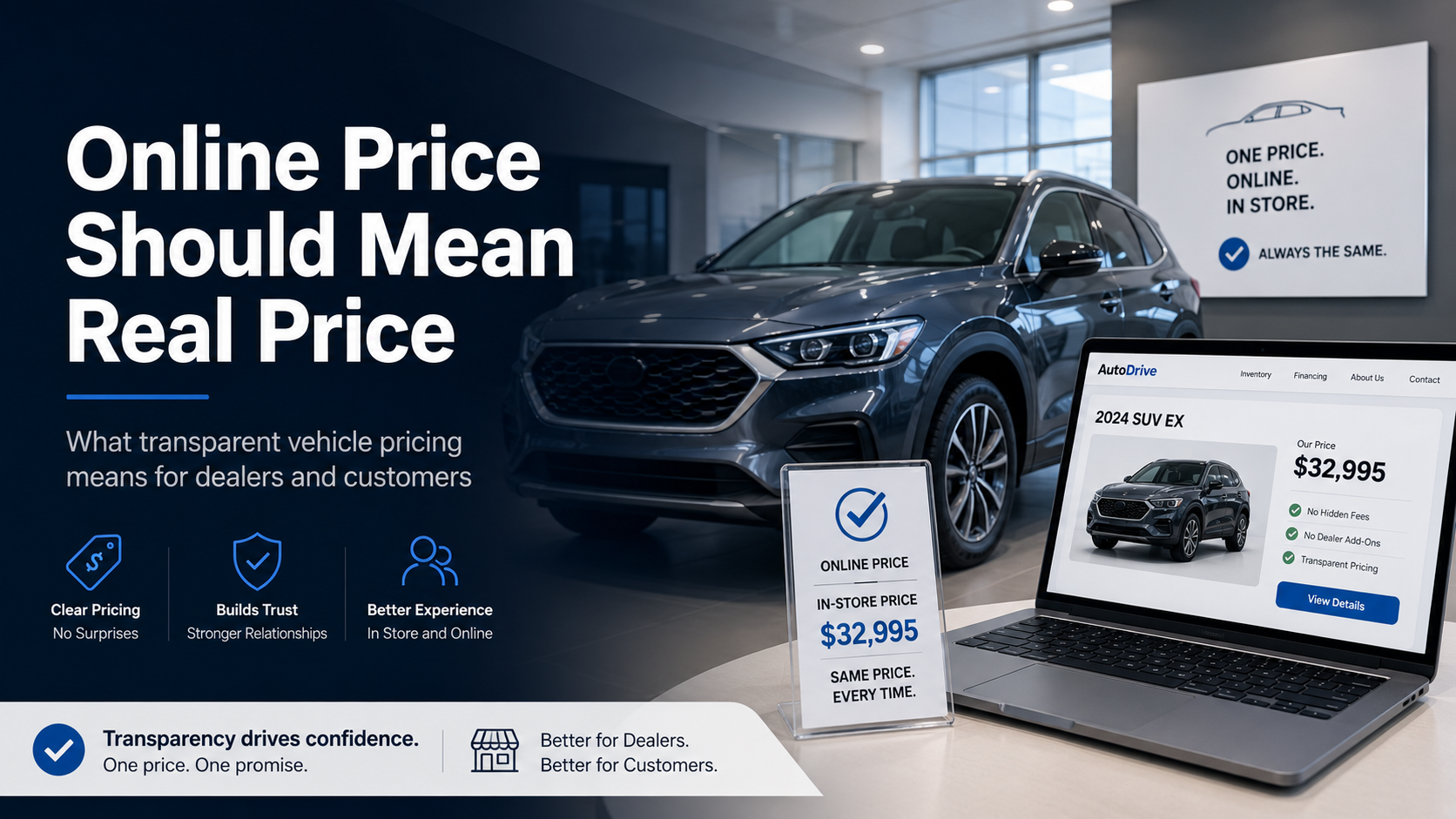
Car buyers are tired of seeing one price online and a different price when they show up at the dealership.
That is the core issue behind the FTC’s recent focus on dealership pricing transparency. In simple terms, if a dealership advertises a vehicle online at a certain price, that price should match what the customer can actually pay when they arrive, excluding government-required charges like tax, title, and registration.
The FTC has made it clear that dealers should not advertise a low online price and then add mandatory fees, products, or upgrades later in the process. In March 2026, the FTC warned 97 auto dealership groups that advertised prices must include all mandatory fees the customer will be required to pay.
What This Means for Customers
For customers, this is about transparency.
You should be able to look at a vehicle online, see the advertised price, and feel confident that the price will not suddenly change when you arrive at the dealership.
A common frustration has been this:
A customer sees a new vehicle listed online at MSRP. They drive to the dealership expecting that price. Once they arrive, they find out the vehicle has additional mandatory add-ons like:
- Window tint
- VIN etching
- Nitrogen-filled tires
- GPS
- Door guards
- Protection packages
These add-ons may already be installed on the vehicle, but the added cost is not always reflected in the online price.
That is where the problem comes in.
If those upgrades are mandatory and the customer cannot remove them from the deal, then the advertised price should reflect that. The FTC has specifically continued to focus on deceptive pricing and unwanted or hidden add-ons in auto sales.
For customers, the benefit is simple: what you see online should be much closer to what you get when you walk into the dealership.
No surprise $3,000 addendum.
No hidden mandatory package.
No bait-and-switch feeling.
Just clearer pricing from the beginning.
What This Means for Dealers
For dealers, this creates a real operational challenge.
A lot of dealerships have traditionally used preloaded add-ons on new vehicles. These are products or upgrades installed before the customer ever sees the vehicle. In many stores, these add-ons are shown on a physical addendum sticker placed on the car.
The issue is not always the add-on itself.
The issue is whether that add-on price is also shown online.
If a vehicle has MSRP plus a mandatory tint package, VIN etching, GPS, nitrogen, or another installed product, the online listing needs to be accurate. The customer should not see one number online and a different required number in-store.
It is worth noting that the FTC’s CARS Rule was struck down by the Fifth Circuit in 2025, but the FTC is still actively using its authority against deceptive pricing and add-on practices.
So even though the legal landscape has shifted, the message to dealers is still clear: advertised pricing needs to be transparent.
The Add-On Dealers Should Pay Attention To: Window Tint
Most customers are not asking for nitrogen tires.
Most customers are not excited about VIN etching.
Most customers already have GPS-style features through factory apps, connected vehicle systems, or their phone.
But window tint is different.
Especially in Texas and other hot-weather states, customers actually want tint. It is practical. It improves comfort. It protects the interior. It makes sense.
That is why tint may still have a place in the dealership process, but it needs to be handled correctly.
Dealers have a few options.
Option 1: Include Tint in the Online Price
If a dealership continues to preload tint on certain vehicles, then the online price should reflect the vehicle price plus the tint.
That keeps the pricing transparent.
For example:
MSRP: $48,000
Tint Package: $499
Online Advertised Price: $48,499
Now the customer knows exactly what they are walking into.
There is no surprise.
There is no awkward conversation.
There is no feeling that the dealership hid the real price.
Option 2: Offer Tint as an Optional Add-On
The dealership can also avoid preloading tint and simply offer it when the customer arrives.
That conversation becomes much cleaner:
“This vehicle does not include tint, but we can add it for you if you would like.”
That makes tint optional instead of mandatory.
The customer gets the choice.
The dealership still has the opportunity to sell the product.
Option 3: Use Tint as a Value Add
Some dealers may choose to include tint as a value benefit on certain vehicles.
Instead of presenting it as an extra charge, the dealership can use it as part of the value proposition.
That may look like:
“This vehicle already includes professionally installed window tint at no additional charge.”
For the customer, that feels like a benefit.
For the dealer, it may help separate the vehicle from similar listings online.
Where AutoFocus Can Help
This is where AutoFocus can support dealerships.
AutoFocus touches every vehicle as part of the inventory media process. Because we are already involved with the car before it goes online, we can help dealerships create a cleaner, more accurate listing process.
If a dealership continues to preload tint or other approved add-ons, AutoFocus can help make sure the vehicle’s pricing presentation is updated properly so the online listing reflects the correct advertised price.
That matters because the vehicle listing is often the first impression.
Before the customer talks to a salesperson, before they visit the lot, before they submit a lead, they are looking online.
If the photos, price, and vehicle details are not aligned, trust can be lost before the sales process even begins.
This Is Not Just a Compliance Issue. It Is a Trust Issue.
Customers do not want to feel misled.
Dealers do not want angry customers walking in already frustrated.
Pricing transparency helps both sides.
For customers, it creates confidence.
For dealers, it reduces friction.
For sales teams, it creates a cleaner conversation.
And for the dealership’s online presence, it builds trust from the first click.
Final Thought
The simple version is this:
If the customer has to pay for it, the online price should reflect it.
If the add-on is optional, make that clear.
If tint is preloaded, make sure the price is transparent.
Dealers who clean this up now will be in a better position moving forward. The stores that make pricing clear, consistent, and accurate online will have a better chance of earning trust before the customer ever steps on the lot.
AutoFocus can help with that process because we are already involved where it matters most: the vehicle, the listing, and the customer’s first impression.
Recent Posts